
 Español
 Português
Stadium Coverage: JPS Gets Drafted for High-Profile Event
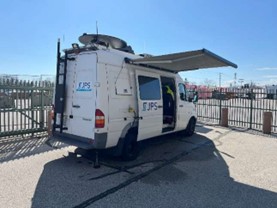
In late April 2025, the JPS Sprinter was deployed to Wisconsin to work with the Green Bay Fire Department to assure communication between the various public safety agencies detailed at an annual, high-profile sporting event.
Challenge
Given the size, complexity, and prestige of the event, Communication Leaders (COM-Ls) had worked together to establish the essential communications needs for the hundreds of personnel who would be providing support and security. Essentially, this consisted of on-site communications infrastructure for regional, State, and Federal authorities as well as contractors and other support personnel.
Specifically, the primary Land Mobile Radio (LMR) infrastructure in this region consists of 700/800 MHz P25 trunked systems which, along with VHF conventional systems and Federal interop 800 repeaters, needed to be interfaced with various simplex VHF Mutual Aid radio frequencies.
To avoid interfering with command post operations and to achieve a higher radio coverage area, the interoperability technologies would be kept separate. Routing audio over a network is quite common, and it would also be used to include the Brown County Emergency Operations Center (EOC), located several miles away, and users of Push-to-Talk over Cellular (PoC) services.
Finally, during site setup and testing (April 21-23), the team identified several additional needs. Specifically, a VHF simplex Mutual Aid channel was not within the coverage area of the public safety staging area, and the aerial assets (Coast Guard, other helicopter operators, and contracted drone operators) had special requirements.
Solution
The JPS Sprinter served as the primary interoperability locale, relying on its ACU®-Z1™ gateway. The Green Bay Fire Department connected appropriate radios and created talkgroups during the initial setup period. Inside the stadium facility 700/800 MHz P25 coverage by temporary repeaters was established. For interoperability, those repeaters were connected to operational radio frequencies using console patches at EOCs and also locally, by patching those radio systems to the various VHF Mutual Aid frequencies being used by personnel throughout the venue.
ACU-Z1
Using the ACU-Z1 gateway, JPS set up four interoperability nets linking the 700/800 MHz systems to the VHF conventional simplex systems. A JPS VIA PoC account was also established so that all communications personnel had access to all radio interoperability net audio on their smart devices, in addition to their own PoC talkgroup communication.
Meeting Unplanned-For Challenges
As mentioned previously, it had been determined during final setup that the VHF simplex channel being used on the other side of the stadium was not in the coverage area of the public safety staging area. To rectify this, JPS and communications personnel deployed a PERC ACU-M kit on the upper level of the stadium, with a host VHF base station to provide better coverage. The RF signal was then converted to JPS Radio over IP (RoIP) and connected to the ACU-Z1 gateway where it was patched into the four interoperability nets.
Real-Time Off-Site Awareness
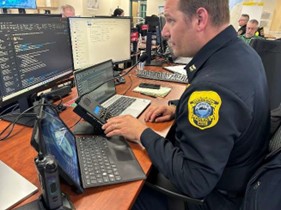
Included in the four interoperability nets were JPS Bridge connections to MCC four-channel PTT Consoles located at the Brown County EOC. This provided the EOC monitor and transmit capability, giving them the same connectivity and real-time situational awareness that on-site personnel had at the stadium.
Aerial and Drone Coverage
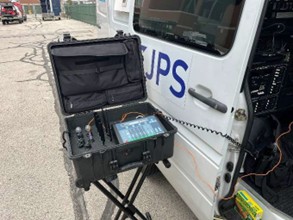
Finally, upon going operational, it was determined that there was an issue with the aerial coverage providers. An ACU-M was deployed with frequencies available to the aerial units and the drone operators. This communications network was initially separate from the other interoperability nets previously established, but it was brought into the event plan as a fifth net on the ACU-Z1, using RF on an 800 MHz frequency.
Results
In total, five interoperability nets were established on the ACU-Z1. These included patches between various 700/800 MHz P25, VHF, and Mutual Aid radio systems, plus MCC-4 IP Consoles, RoIP, and PoC links, all of which were used for event support operations and security.
Logistically, by keeping the interoperability technologies and the command post separate, the radio and gateway infrastructure could be located at a higher radio coverage area, and did not interfere with command post operations.
In addition to the ACU-Z1, the deployed JPS ACU-M gateways added the flexibility to deal successfully with the unexpected.
In summary, this event highlights how the strengths of individual communications systems (LMR, RF, IP, RoIP, PoC, LTE) can be drafted and worked into an interoperability team ready to handle large events.