
 Español
 Português
JPS at APCO 2024 – new CPM-5 for the SNV-12 and more
We’re excited to be back at APCO this year! It’s always energizing to talk to folks and learn about all the interesting ways you integrate JPS products into your communication systems. We also just can’t help ourselves from telling you about the new CPM-5 for our SNV-12 Voter.
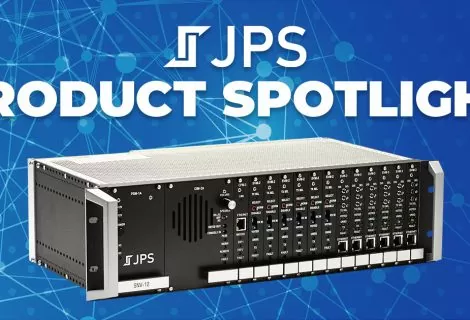
CPM-5 Voter Control Module
Like its predecessor, the CPM-3, the CPM-5 is backwards compatible and fully capable of voting audio from IP, traditional analog, or a mix of IP and analog backhauls from remote radio sites. Differentiating from its predecessor, the CPM-5 also:
- Provides SNMP alarm monitoring
- Is remotely configurable (no more DIP switches)
- Includes user selectable RoIP Audio Routing
- Supports up to 108 RX sites in a multi-chassis system
The new CPM-5 has the processing power to support SNMPv3 (Simple Network Management Protocol), which provides advanced alarm capabilities to SNV-12 users. Traps can be displayed on a Network Manager, and the associated Management Information Base (MIB) will enable monitoring of connected SNV-12 Voters for alarms. When an SNV-12 user receives an alarm indication, a query can be done easily on the SNV-12 Voter by browsing to its IP address. Like all JPS software, when the CPM-5 is released, the MIB will be available on the JPS website for customer download.
Another convenient feature of the CPM-5 is that it is remotely configurable. Where DIP switches and the physical presence of an on-site technician were required for the CPM-3 to enable or disable functions like STARS TX Steering, Repeat Mode, Group Lockout, etc., CPM-5 configurations are selectable using a web browser. That makes the CPM-5 – and subsequently your SNV-12 Voter – easier to manage.
The CPM-5 also expands an existing function. In addition to being able to monitor the SNV-12 Voter using RoIP, the CPM-5 makes it possible to send audio to the Voter using RoIP. Incoming RoIP audio – streaming from an NXU-2B or an RSP-Z2, for example – can be transmitted to the Default TX site, transmitted to all TX-capable sites (all call), or treated like a Remote site (Voted site). If treated like a Remote/Voted site, the RoIP audio is routed to the Console and all Repeat sites, much like a Forced Vote or a Manual Selection, and the user can still monitor voted audio even if Repeat Mode is not enabled.

Additionally, the increased processing power of the CPM-5 removes the previous limitation of 60 on the number of sites a multi-chassis, expanded system can manage. Therefore, if all twelve Site Voter Module (SVM) slots are populated with SVM-3s, each of which can link to up to three QMT-1Bs at remote RX sites, one chassis can support up to 36 IP backhaul sites. Add another chassis to the first (36 x 2) for up to 72 IP backhaul sites. Add yet a third chassis (36 x 3) and the CPM-5 can vote audio from up to 108 IP backhaul sites in a multi-chassis, expanded system.

Early versions of the CPM-5 for the SNV-12 Voter have been on field evaluation with a major subset of new functionality since early spring 2024, and the CPM-5 will be shipping from stock in 12-14 weeks. If you would like to learn more, stop by the JPS booth #1701 at APCO, or email sales@jps.com

JPS Interoperability Demonstrations at APCO
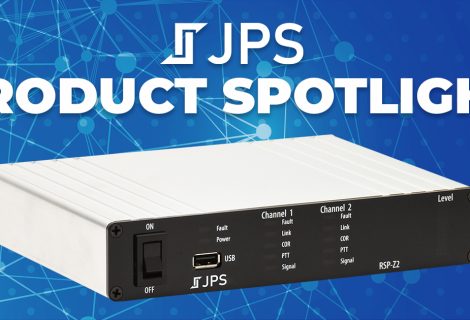
RSP-Z2 Dual-Channel Interoperability Gateway
- Link natively to Push-to-Talk over Cellular (PoC) systems (e.g., AT&T Enhanced PTT, ESChat, Motorola WAVE PTX, Verizon Push to Talk Plus, Zello)
- Communicate with tone-controlled radio systems with EIA Tone Keying
- Intelligently integrate with trunked radio systems using Adaptive TX Delay
- Navigate phone systems with DTMF injection on all resource types
- Solve complex interconnectivity problems like radio “squelch tails” using audio flow control adjustability
- Interact with SIP devices and SIP PBXs, including advanced firewall navigation options like ICE and TURN
- Identify and locate network problems using built-in network diagnostic tools
- Connect to the vast quantities of older but still deployed JPS equipment
- Expand the reach of your RSP-Z2 by making it part of a large-scale interoperability system using Unity
- Send audio to network recorders, make one-way audio patches, customize the resource display, and more…
Z-Series Controller
- All of the above RSP-Z2 capabilities when controlling distributed RSP-Z2s using Unity
- Experience the significant and growing management and control features to configure and maintain distributed RSP-Z2s
- Link audio across multiple distributed systems with an intuitive drag-and-drop interface
- View and configure settings for both local and distributed resources
- Easily maintain, configure, and troubleshoot system-level settings on distributed systems (update software, adjust network settings, restart remotely, etc., coming very soon in release 4.6.0)
- Interact with the audio in your system using multi-user lightweight dispatch; dispatchers do not interfere with or hear each other’s dispatch audio unless desired
- Link to MCC Consoles, older JPS equipment, and other unique audio endpoints using built-in, network-centric resources
- Customize your experience with resource favorites and other personalized resource grouping
- Monitor the traffic moving through your system with the convenient Listener feature (coming very soon in release 4.6.0)
See More and Learn about All our JPS Products

Our Experts are On Hand
Stop by our booth #1701 at APCO or send us an email. With more than 30 years in the industry, JPS has the knowledge and experience to help you find the solution that works best for you. We look forward to seeing you!