
 Español
 Português
Sheriff’s Deputies Use LMR and LTE to Overcome Topography and Distance
The Story
Land Mobile Radio (LMR) coverage areas can be limited by a variety of factors such as topography (mountains, valleys), other communications systems in the area, or distance from a transmitter or receiver. Being out of primary radio coverage reduces the capabilities of emergency services personnel, and – in some cases – puts them at personal risk. The Calaveras County Sheriff’s Office wanted to change that.
Learn how JPS products helped this County Sheriff with LMR/LTE coverage expansion.
The Challenge
Deputies often use cellphones to perform their day-to-day duties, but during critical moments the use of radios allows for expedient interaction with dispatch, as opposed to fumbling with a cell phone. Radio – capable of reaching command staff and dispatch – is far more reliable but limited in range.
The challenge lay in utilizing the best of both technologies: the coverage and convenience of LTE cellular service and the proven reliability of land mobile radio. Since each patrol vehicle was already outfitted with an LTE router, the solution would not be particularly difficult or expensive. All that remained was to leverage the superior LTE network coverage to enhance traditionally reliable LMR communications.
The Solution
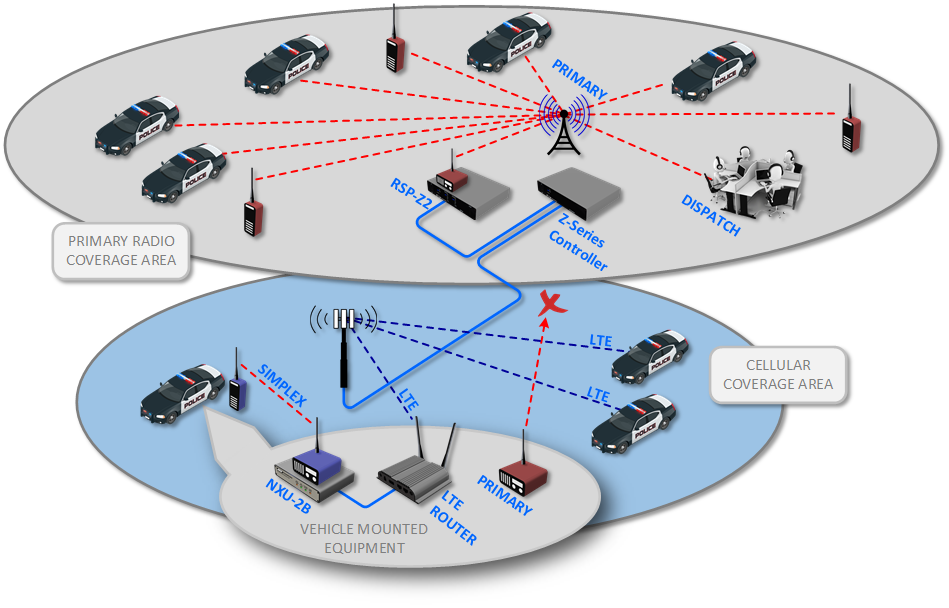
In many cases, LTE cellular data coverage was still available even when the agency’s primary channel or normal radio coverage was not. Since each Sheriff Deputy’s vehicle already had an existing LTE network router installed, it was easy to integrate a JPS NXU-2B Network Extension Unit with a second mobile radio, set to simplex mode. The NXU-2B converts the radio’s audio to Radio over IP (RoIP) and vice versa, which allows audio from that second mobile radio to be sent from anywhere LTE coverage was available. Even in limited radio and LTE service areas, the NXU-2B’s minimum bandwidth requirements would allow officers to make voice calls from the second mobile radio.
In this case, audio converted by the NXU-2B in each Sheriff Deputy’s patrol vehicle is sent to a Z-Series Controller and associated to a single RSP-Z2 Gateway, both located at the main dispatch center. The RSP-Z2 provides full connectivity to the agency’s primary radio channel. This allows the deputy to use his portable radio in poor LMR coverage areas to communicate with the simplex mobile radio that is linked over the LTE network to the primary radio channel network. Columbia Communications, Inc., a JPS authorized dealer, purchased the equipment from JPS, and integrated the solution into the fleet and assets at the dispatch center.
The Result
The mountainous terrain…creates challenges when implementing a radio system…for public safety. Utilizing JPS RoIP technology in place of a traditional system has expanded radio coverage.
-David Ethier, Columbia Communications, Inc.
Deputies have the tools to be safer and more effective in their jobs when outside of the normal radio coverage area. The use of RoIP and the available LTE network coverage has mitigated a common deputy safety issue. When a deputy is operating outside of the normal radio coverage area, a portable radio set to the simplex channel allows the deputy to speak on the duplex primary channel using a series of links and audio type conversions made by JPS gateways and transmitted over the LTE network. The radio coverage area is effectively expanded.