
 Español
 Português
County Firefighters Gain Radio Coverage, Keep Pine Trees
Sometimes, pine trees just get in the way of LMR communications. That’s part of why a rural county’s fire department turned to JPS for a solution.
Challenge: Pine Trees Obstruct LMR
Pine trees – especially the longer-leafed variety common to the Eastern and Southeastern US – tend not to play nicely with UHF radio waves. Since the county was heavily forested as well as mountainous, the trees were interfering with the primary fire station’s LMR (Land Mobile Radio) transmission, making communications to and from the station unreliable. Allowing that to continue was simply not an option for public safety.
As it turns out, this particular county had another fire station with absolutely fantastic LMR coverage. Unfortunately, that station was only manned during the more fire-prone seasons, leaving it generally unmanned.
So, they had a fire station with no people but excellent LMR coverage, and another station with people but lousy LMR coverage. Moving the people to the more ideal radio site was a non-starter. Instead, they wanted to know how to get the LMR audio to the people. That’s where JPS could help.
Solution: RoIP
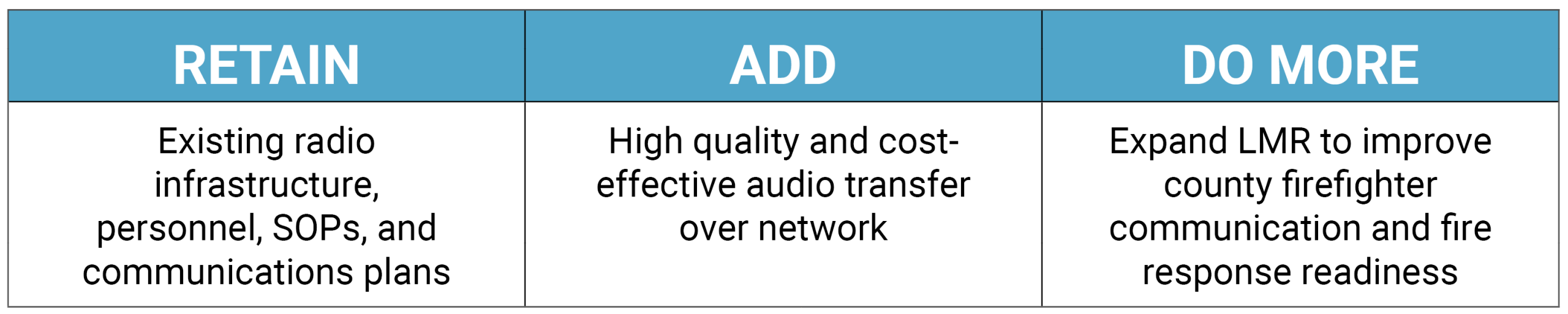
Radio over IP (RoIP) was invented in 2000 by one of JPS’ engineers to solve problems exactly like this. Whether a radio wave is being blocked by geography, by buildings, by distance, or by vegetation, once you convert that LMR audio to a digital format, it can be sent over a network anywhere in the world. The NXU-2B single-channel gateway provides a simple, cost-effective, hands-off option to introduce RoIP to these fire stations.
Therefore, an NXU-2B is installed at the unmanned fire station where the LMR coverage footprint is large. When radio audio is received, it is converted to RoIP and sent over the network from the unmanned station to the manned station. At the manned station it is met by another NXU-2B that reconverts it from RoIP to LMR audio so that the firefighters hear it on their subscriber units.

In turn, when one of the firefighters speaks into their subscriber unit, it goes to the NXU-2B at the manned station, is converted to RoIP and sent to the unmanned station, where it is reconverted to LMR audio and transmitted out.
How does this affect the unmanned station during the seasons that it is manned? Really, not at all. Even though the donor radio connected to the NXU-2B at this station continues to interact with the LMR system, the firefighters stationed there use their radios as they normally would. They don’t need to do anything different.
How much time does it take for the audio to go from one station to the other? To the firefighters using the radio system, the transit time is undetectable. What’s more, since the signal is more reliable than it was before the introduction of the JPS gateways, the user experience is improved.
Learn More
The NXU-2B is a single-channel radio-to-RoIP converter that continues to be used in sectors as diverse as education, law enforcement, utilities, tourism, transportation, etc. However, as the need to include Push-to-Talk over Cellular (PoC) support and/or additional LMR radio channels has increased, the RSP-Z2 has increasingly become the go-to gateway.
Using RSP-Z2s instead of NXU-2Bs at these fire stations, we can create that same LMR-to-RoIP link, accomplishing the same primary goal. Additionally, each station will have three more two-way resources available for use with PoC apps, VoIP, RoIP, other LMR systems (max 2 per gateway), etc.